

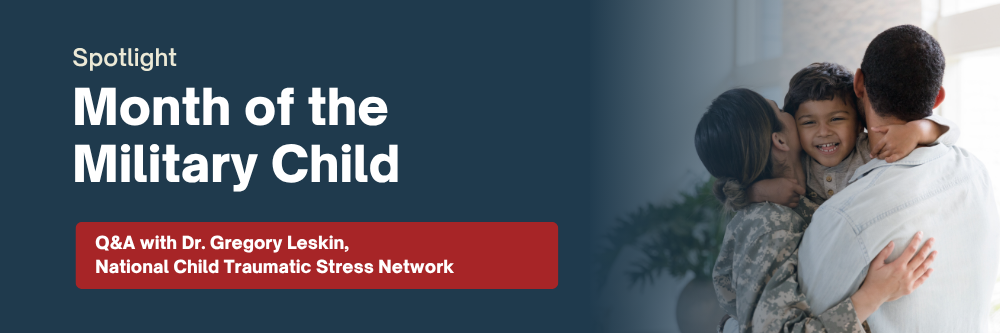
The Month of the Military Child, recognized every April, honors the more than 1.6 million children who face unique experiences and challenges as members of military families. Across the world, military bases, cities, and schools hold special events to celebrate and thank military youth such as wearing purple on April 15, known as Purple Up Day, offering salutes to military children at sporting events, and building special displays in public spaces like school hallways.
At SAMHSA’s Service Members, Veterans, and their Families Technical Assistance Center (SMVF TA Center), we’re celebrating with a wide-ranging conversation with Dr. Gregory Leskin. Dr. Leskin is a licensed clinical psychologist and serves as Program Director for the National Child Traumatic Stress Network’s (NCTSN) Military and Veteran Families Program at the University of California, Los Angeles/Duke University National Center for Child Traumatic Stress. In this role, he leads efforts to provide education, training, and practical resources on military culture, screening, assessment, and evidence-based interventions for behavioral health providers across the United States, including clinics based in the community, within VA medical centers, and on active military bases. He also directs the NCTSN/Department of War (DOW) Academy on Child Trauma, an online training platform developed to strengthen trauma-informed practice with military children and families.
In this interview, Dr. Leskin reflects on what we’ve learned about childhood trauma, provides guidance for programs and individuals working with military children, and uplifts a wealth of resources for supporting SMVF.
The Month of the Military Child was established in 1986 to recognize the sacrifices of military children and their unique challenges. In the years since, the behavioral health field has made many strides in our understanding of childhood trauma and resilience. What do you see today as exciting opportunities for continued research and innovation? What, if anything, has surprised you in the course of your work?
One of the most exciting opportunities today is that we can move beyond identifying risk factors and continue building systems of family support that are practical, coordinated, and accessible for military-connected children and families. We now know much more about the unique stressors military children face, including frequent moves, repeated transitions, separation from parents during deployments, and the increased stress and burden often carried by the caregiving parent at home. We also know that children experience those challenges within their larger ecosystem which includes family relationships, schools, peer networks, and communities. That creates important avenues for innovation such as strengthening support not only for children, but also for parents, caregivers, educators, and the civilian and military systems that surround them.
I am especially encouraged that we have identified excellent opportunities for support for adults, families, and children that can reduce stress, improve relationships, strengthen parenting, and improve children’s emotional and behavioral functioning. These services can be offered in classrooms, groups, family settings, and individual sessions, which gives us many more ways to reach children earlier and more effectively. My goal is to continue increasing access to these services in both the military and civilian sectors, as well as create pathways for warm handoffs between the sectors.
What has surprised me most is that stigma around seeking mental health support can still be so strong, even when families are under significant stress. At the same time, I have also been struck by how much progress is possible when support is visible, trusted, and easy to access. We are continuing to recognize that mental health needs among military-connected children have increased, and that makes it even more important that we keep acknowledging their experiences and building supportive schools and communities around them. In my work, I have seen again and again that when adults are available, when peers are ready to listen, and when families feel supported rather than judged, children are better able to adapt and thrive. It is also vital for supportive civilian communities to build ties with military family support programs to enable communication and coordination.
What advice would you give to teams that may be considering strategies to support the mental health and well-being of military children, particularly in times when discussions of war may be more pervasive in a child’s daily life?
My advice would be to start with the whole child in context. Military children are not carrying these experiences alone. They are affected by what is happening at home, by the stress level of the caregiving parent, by transitions in school and community, and by the broader realities of military life. In times when discussions of war are more present in the news, social media, or everyday conversation, children need calm, steady, trusted adults who can help them make sense of what they are hearing in ways that are honest, developmentally appropriate, and reassuring. They also need routines, emotional safety, and opportunities to ask questions and express feelings without taking on the weight of adult fears and worries. They need an adult who is emotionally attuned to their concerns and offers safe and trusted reassurances.
I would also encourage civilian programs to think about support as something that should be built into everyday settings, not reserved only for times of crisis. Children need to see and feel that support is available. Signs of support matter. When a child enters a new school or community and quickly learns that adults are paying attention, that peers are ready to help, and that there is a place for them there, it can make a real difference. Those signals communicate something powerful: you belong here, and you matter to us that you are here with us now.
It is also important for teams to recognize that family strength is closely tied to military readiness. Supporting the well-being of children and families is not separate from supporting the warfighter. It is part of the readiness of the force. The stronger and more connected the family system is, the better positioned everyone is to manage stress, adapt to change, and seek help early when needed. That is why the best strategies are the ones that coordinate support across family services, schools, behavioral health systems, and community partners in both military and civilian settings.
In recognition of the Month of the Military Child, what resources would you most like to uplift for our audience?
I would most like to highlight resources that help military-connected children feel safe, supported, and connected across the places where they live, learn, and grow. Programs from ZERO TO THREE are incredibly important for military and veteran families with very young children, because they support early relationships, healthy development, and caregiver capacity during times of stress and transition. I would also highlight the National Children’s Alliance, especially for the important role it plays in strengthening responses for children and families through military-informed child advocacy centers (CACs) and coordinated systems of care.
For schools and communities, I would especially want to recognize the Military Child Education Coalition, including its Student 2 Student program. Programs like Student 2 Student help children do more than adjust to a new school. They help children feel that they belong, that they are seen, and that they matter to both peers and adults. That sense of connection can be incredibly protective for children who are navigating frequent moves and transitions.
I would also highlight resources such as Military OneSource, school liaison supports, and trauma-informed tools for providers, educators, and caregivers who work with military-connected families. In addition, I want to mention the work I have been doing with communities through MiTi Kids, which focuses on coordinating civilian and military child services so that families experience support as connected rather than fragmented. A major goal of this work is to strengthen military-informed, trauma-informed approaches and improve access to services for military children and families in the places where they already are. For more information about MiTi Kids or NCTSN Military and Veteran Families, please contact militaryfamilies@nctsn.org. I am also available to provide training on military-informed, trauma-informed approaches and services.
In honoring the Month of the Military Child, I think it is especially important that we continue recognizing these children not only for their resilience, but also for the very real challenges they carry. Military children deserve to be acknowledged, supported, understood in their homes, in their schools, and in their communities.
About the NCTSN Military and Veteran Families Program
The NCTSN Military and Veteran Families Program was established to adapt the Network’s child traumatic stress expertise to the needs of military and veteran children and families. The program develops trauma-informed resources and training for both community providers and military installations, with attention to the effects of wartime deployment, parental mental health and injury, grief and loss, child maltreatment, and other stressors that can affect children and families across the military experience.
Featured NCTSN Resources
Understanding Child Trauma and Resilience: For Military Parents and Caregivers offers military parents and caregivers clear information about child trauma and resilience, including how traumatic experiences can affect military families and common reactions children and teens may show. The fact sheet also includes a behavior checklist, questions to ask providers about treatment services, and guidance for talking with children of different ages after a traumatic event.
For Military Parents and Caregivers: Supporting Your Children Throughout Deployment provides practical ways to reduce the negative effects of deployment, including maintaining caregiver well-being, fostering positive family dynamics, and using effective parenting strategies. It recognizes that deployment or increased operational tempo, especially to a combat zone, can be one of the most significant stressors on a military family, while also emphasizing the resilience many military children show.
Special thanks to Dr. Gregory Leskin for sharing his expertise and for his contributions to the work of preventing suicide among SMVF.
Thank you for your continued support and dedication to improving behavioral health care for those who have served, and are currently serving, our country.
SAMHSA’s SMVF TA Center is honored to provide TA to states, territories, and communities seeking to strengthen their behavioral health support for those who have served in the armed forces. For TA inquiries, please email smvftacenter@prainc.com. For more information about the SMVF TA Center and the resources offered, please visit SAMHSA’s SMVF TA Center’s web pages.