

In 1948, the Women’s Armed Services Integration Act allowed women to serve as regular members of the military. Today, there are more than 2 million women Veterans living in the United States, and they are the fastest-growing group in the Veteran population.[i] As the number of women serving our country continues to grow, it is important to bring awareness to how their experiences while serving and following separation from the military can be quite different from their male counterparts. It is known that women who have served are more likely to have faced compounded traumas such as military sexual trauma, intimate partner violence, and moral injury. As Veterans, women are often misidentified and therefore underserved. But there are some common expectations within a military family that can be overlooked when considering the unique challenges of women Veterans.
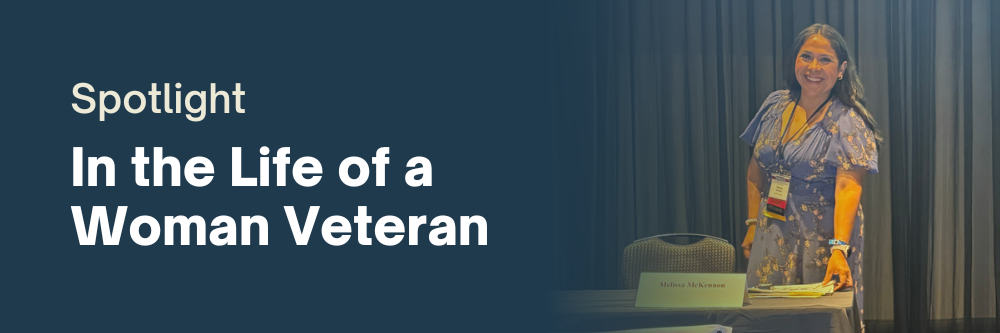
For example, when Melissa McKennon, a U.S. Army Veteran, peer support leader, and suicide prevention advocate, enlisted in the U.S. Army at 17, she was searching for direction. A first-generation Mexican American and self-described “kid with a chip on her shoulder,” Melissa found purpose in the structure and discipline of military life. But like many women Veterans, some of the challenges she faced as a female in the military proved harder to navigate than the uniformed service itself.
Melissa and her husband met and married while serving and became parents while both were active duty. Dual-military couples are known to encounter unique stressors, including coordinating deployments and family responsibilities, which can impact retention and family life.[ii][iii] This was true for Melissa and her husband. When their deployment orders arrived, their son was 18 months old, and Melissa was assigned to Iraq and her husband to Egypt. The only solution they could come up with was to send their son to stay with extended family. They decided this was not a viable option, and Melissa made the decision to leave the Army, sacrificing a deployment she had long trained and hoped for. “That’s my kid,” she said. “I couldn’t do it. It wasn’t just a career decision…it was a rupture in my identity,” she remembers. “He got to stay in. I stayed home. I lost my identity,” Melissa said. “I went from being full-time Army to a stay-at-home mom.”
Years later, Melissa’s husband was medically retired from the military, and she would again need to step into a caregiving role. “There was no manual for what it meant to be a military spouse when you used to wear the uniform yourself,” she said. She fell into the expectation that she would transition seamlessly into a caregiver role without recognition, compensation, or support.
Women Veterans often leave service carrying invisible burdens, some of which they feel they cannot share. “There’s this fear that if I tell someone I’m suicidal, they’ll report me or take my kids. If I talk about what’s going on at home, what happens next?” Melissa shared. “It’s not just stigma. It’s survival.”
Even with knowledge of the system, navigating the U.S. Department of Veterans Affairs’ (VA) referrals, long waits, and provider turnover were daunting. “I knew the steps, but I didn’t feel seen. I didn’t feel safe.”
Melissa praises the power of peer support for getting her through the most difficult challenges.
It was the peer-led spaces where Melissa found a renewed sense of belonging. “Peers became my voice when I lost mine,” she explained. “They brought me back to faith, helped me take ownership, and reminded me I wasn’t alone.”
Peer-centered programs like WoVeN, and Grace After Fire provide a social support network for women Veterans. They can connect with others with similar experiences and learn that they have resources available to support their and their family’s success. Melissa firmly believes, “If you can’t find your tribe, you’ve got to build one. You are worth more than anything in this world.”
Melissa’s story is a powerful reminder that women Veterans have different experiences, challenges, and needs that they may not share for one reason or another. If you are a woman who served or know someone who is, please check out the Resources section below.
Special thanks to Melissa McKennon for sharing her story. She is a U.S. Army Veteran, peer support leader, and suicide prevention advocate based in San Antonio, Texas. She serves as a consultant for the Substance Abuse and Mental Health Services Administration’s (SAMHSA’s) Service Members, Veterans, and their Families (SMVF) Technical Assistance (TA) Center, uplifting Veterans through faith, fellowship, and community engagement. She has been featured in media outlets and acknowledged for her contributions to the Veteran community.
SAMHSA’s SMVF TA Center is honored to provide TA to states, territories, and communities seeking to strengthen their behavioral health support for those who have served in the armed forces. For TA inquiries, please email smvftacenter@prainc.com. For more information about the SMVF TA Center and the resources offered, please visit SAMHSA’s SMVF TA Center web page.
References
[i] U.S. Department of Veterans Affairs. (2022). Women veterans in focus. Office of Women’s Health, U.S. Department of Veterans Affairs. https://www.womenshealth.va.gov/materials-and-resources/facts-and-statistics.asp#:~:text=More%20than%202%20million%20Women,fastest%20growing%20group%20of%20Veterans.
[ii] Gonzalez, M. L., & Baxter, J. (2017). Face of defense: Dual military couple tackles challenges. U.S. Department of Defense News. https://www.defense.gov/News/News-Stories/Article/Article/1183842/face-of-defense-dual-military-couple-tackles-challenges/
[iii] Segal, M. W., Smith, D. G., & Segal, D. R. (2017). Dual military couples: The experiences of women in the all-volunteer force. In C. L. Williams & K. Dellinger (Eds.), Gender and sexualities in the military: Past, present, and future (pp. 199–218). Springer. https://link.springer.com/chapter/10.1007/978-3-319-66192-6_11
Like what you’ve read? Sign up to receive the monthly SMVF Topics in the News!