

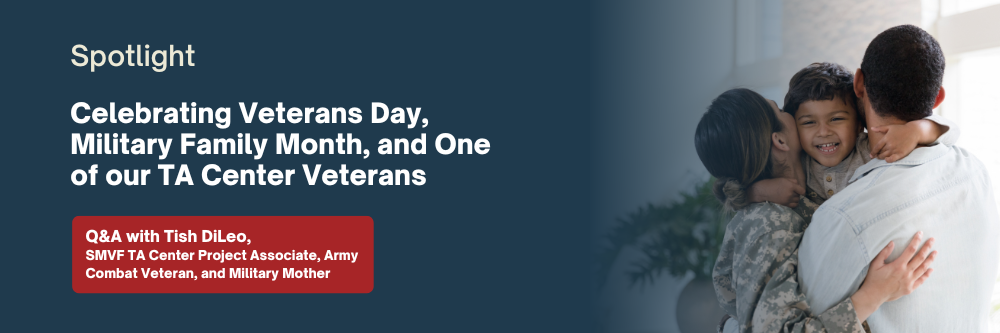
November offers multiple opportunities to celebrate service members, Veterans, and their families, including Veterans Day, the United States Marine Corps Birthday, and Military Family Appreciation Month. At the end of October, the SMVF TA Center also said goodbye to Tashawnya “Tish” Di Leo as she transitioned into retirement.
An Army Combat veteran and parent to two service members herself, Tish embodies the convergence of many of these identities. In this interview, celebrating both Tish and the multifaceted experience of Veterans and their families, Tish shares how years of military service and transitioning to civilian life shaped her exemplary career. Plus, hear from those whose Governor’s Challenge work was supported by Tish’s dedication and support.
Over the last six years, Tish provided technical assistance to many states, territories, and local communities, working to strengthen their behavioral health systems for SMVF. Drawing on her own experiences, she has dedicated herself to supporting her brothers and sisters in arms and their families. Previously, she has also served as Director of the Veterans Mental Health Department (VMHD) at Texas Veterans Commission, Manager of VMHD, VMHD Military Veteran Peer Network Peer (MVPN) Coordinator, MVPN Statewide Training Manager, MVPN Peer Service Coordinator, and Grace After Fire Outreach Coordinator. Over the years, she has trained hundreds of peers, mental health professionals, and law enforcement with the emphasis on suicide prevention, de-escalation and peer support.
You have dedicated many years to supporting Service Members, Veterans, and their families. What brought you to this work?
I came to this work purely as an accident. After serving 20 years in the US Army, I was not sure what I was going to do. I was a food inspector as a Soldier and knew that was not what I wanted to do as a second career. About 10 months prior to separating from the Army, I was at a community meeting representing Service Members. After the meeting, I was approached by the CEO of Grace After Fire. She asked me to coffee, stating that she wanted to know more about me and what my plans were for the future. There, she asked me to come to work for her and my fellow sisters in arms as an Outreach Specialist. This work was so fulfilling! In my mind, I was continuing to take care of Soldiers, Airmen, Marines, Seamen, and Coast Guardsmen, so it was a natural fit.
Then, like they say, the rest is history. I started out as an Outreach Specialist. Then, I became a Peer Support Specialist, then State Training Manager for the Military Veteran Peer Network in Texas at the Texas Veterans Commission. After that, I was promoted to the manager for that program and, eventually, the Director of the Veteran Mental Health Department. After serving over 5 years in state government, the opportunity to come to PRA was presented, and I jumped on the opportunity.
How have your own experiences informed the way you work with teams or how you think about supporting SMVF?
I believe that the way that I support each team is by putting myself in their shoes and asking myself what would work best for me. I struggled with transitioning from in uniform to out of uniform. I had to learn a whole new way of communicating with civilians. My children knew nothing but the Army life. My own mental health and symptoms were making it difficult to see beyond my own circumstances. Therapy, along with the love and support of my family and close circle of friends, is what saved me.
So, to answer the question again, my own experiences were constantly influencing the work that I had the honor to do.
Are there any favorite memories or proudest moments you’d like to share?
This is a hard one because it is such a privilege to do this work. If I had to pick one thing about the time I’ve been at PRA, it would be that I love this company. I love my team. I appreciate the values that PRA emulates. It hasn’t been until the last several weeks that I realized how much PRA has done for me. It has truly helped me to transition even more, in a healthy way, from service to civilian life. Even though it’s been 15 years since I separated, I am still healing and growing as a person. PRA was an exceptional place to accomplish this.
As you reflect on the work you’ve done and the impact you and the teams you support have had on communities, what advice do you have for others?
“There’s only one way to do it wrong and that’s to do nothing at all.”
In preparation for this newsletter, leaders in several states that worked closely with Tish shared the following about their experiences with Tish and how she shaped their work:
Special thanks to Tish Di Leo for her commitment to supporting Veterans’ mental health and ending Veteran suicide. Additional thanks to those who shared their experiences with Tish ahead of her retirement.
Thank you for your continued support and dedication to improving behavioral health care for those who have served, and are currently serving, our country.
SAMHSA’s SMVF TA Center is honored to provide TA to states, territories, and communities seeking to strengthen their behavioral health support for those who have served in the armed forces. For TA inquiries, please email smvftacenter@prainc.com. For more information about the SMVF TA Center and the resources offered, please visit SAMHSA’s SMVF TA Center’s web pages.