

Across the country, there is an increasing number of people needing help for mental and substance use disorders. This combined with a demand for person-centered yet cost-efficient responses to those needs to generate a variety of response models with staffing patterns designed for specific needs. For Tulsa, Oklahoma, the longstanding collaboration among its Family and Children’s Services (FCS), the Tulsa Police Department (TPD), and the Tulsa Fire Department (TFD) paved the way for multiple paths to assistance.
“We have different staffing models at different times, but they’re all coordinated,” Justin Lemery, chief of emergency medical services for TFD, points out. “They function together in the same system in a really good way. I think this approach may be unique to our city, and it works.”
It all began with FCS’s establishment of Community Outreach Psychiatric Emergency Services (COPES) in 2001. This 24/7, free mobile crisis program seeks to stabilize, in the least restrictive environment possible in place, anyone with a mental illness that may be causing them to experience suicidal or homicidal thoughts, or whose mental health is decompensating. From the beginning, law enforcement was trained on using COPES as a tool and called upon when needed.
Eager to maximize the opportunities inherent to this de facto partnership, representatives from FCS, TPD, TFD, the Mental Health Association Oklahoma, NAMI (National Alliance on Mental Illness) Oklahoma, and various groups from Tulsa and the surrounding community met with their peers in Colorado Springs to learn about its co-responder model. Seeds planted during that 2017 visit quickly took root.
Community Response Team
Shortly after meeting participants returned from Colorado, a Community Response Team (CRT) was established in Tulsa as a pilot program. It now provides services 5 days per week, responding to a variety of incident types. The team is made up of three members who respond as a unit: mental health crisis and overdose.
- A COPES clinician provides an immediate assessment of the individual’s mental health and referral to appropriate services.
- A TPD officer who has completed Crisis Intervention Training (CIT) focusses on de-escalation and handles any safety issues or threats to the public.
- A CIT-trained TFD paramedic addresses medical needs of the individual.
Integrated Response Team
The most recent addition to Tulsa’s evolving programs is the introduction of the Integrated Response Team (IRT), which involves assigning a COPES clinician to one-third of the city. Embedded in a TPD patrol division, each clinician carries a police radio and responds to calls from any officer in that division.
“I call IRT a force multiplier,” comments Amanda Bradley, vice president for COPES at FCS. “Our IRT clinicians move from call to call to call with various officers, responding to crisis during the evening hours. In CRT, the clinician exclusively accompanies a specific officer, providing services during the day.”
TPD Captain Shellie Seibert wholeheartedly agrees. “We’ve always had COPES available to us, but now the clinicians are right there at the squad table, developing strong relationships with the officers. It’s changing police culture about crisis calls.”
Building on Success
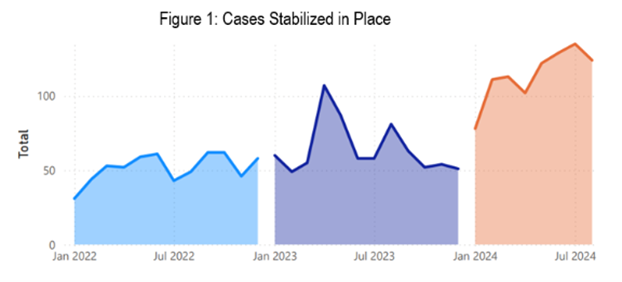
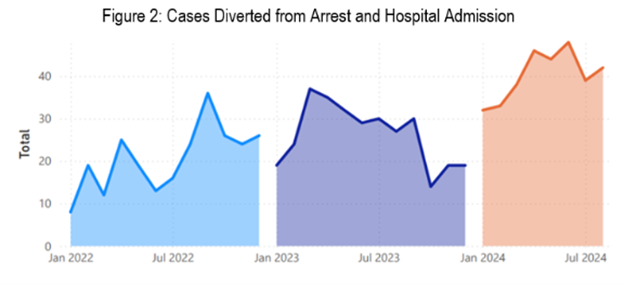
In the 18 months ending in July 2024, the number of cases stabilized in place, which includes follow-up for safety planning and linkage to mental health treatment, increased substantially (Figure 1). So did the number of cases diverted from arrest and hospital admission (Figure 2).
The benefits of these changes can be felt far beyond the lives of the individuals receiving services. When co-responders arrive on scene, law enforcement, paramedics, and fire personnel who were also dispatched on the call can go back into service to assist on other emergency calls—a win-win for the entire community.
Tulsa is continuing to bolster its crisis response systems, currently piloting an enhancement to its 9-1-1 center with a crisis call diversion matrix. Since 2020, a COPES clinician has been available in the 9-1-1 center during weekday business hours for post-call follow-up. With the new crisis call diversion matrix, a COPES clinician will be present 24/7 to facilitate a warm transfer to services and support during the initial 9-1-1 call (with navigation assistance from a case manager). Individuals will be connected to services more quickly, and the appropriate co-responder team will be dispatched more efficiently.
The case manager also participates in weekly treatment team meetings with TPD, which provides a back-end mental health response that was previously lacking. Seibert explains, “TPD and TFD have always been responsible for the front-end response, but in too many cases, we never know what happened to callers after that interaction. Did they get to their outpatient appointments? Were families connected to the services they need? Now, we all collaborate on long-term solutions, which keeps us informed and accountable.”
Bradley adds, “An individual’s crisis may present as a mental health condition, but rarely does that occur in a vacuum. Our back-end navigation process helps us figure out what else may be precipitating the crisis, what social determinants of health may be involved.”
Advice to Other Communities
The City of Tulsa is quick to acknowledge the mentorship of Colorado Springs in establishing CRT and of Harris County, Texas, in embedding clinicians in a 9-1-1 system. But one approach may not work for every community. Lemery recommends, “Determine your community’s needs first. Identify the pressing issues and then find out who already addresses them. Start building relationships; they will be pivotal when you are ready to implement programming. For example, the success of crisis diversion is far more likely when law enforcement has the support of a crisis receiving center. We’re very fortunate here in Tulsa in terms of tremendous community and strong infrastructure, but every community has its own strengths and resources to leverage.”
For more information, contact:
- Amanda Bradley at abradley@fcsok.org
- Justin Lemery at jlemery@cityoftulsa.org
- Shellie Seibert at sseibert@cityoftulsa.org