

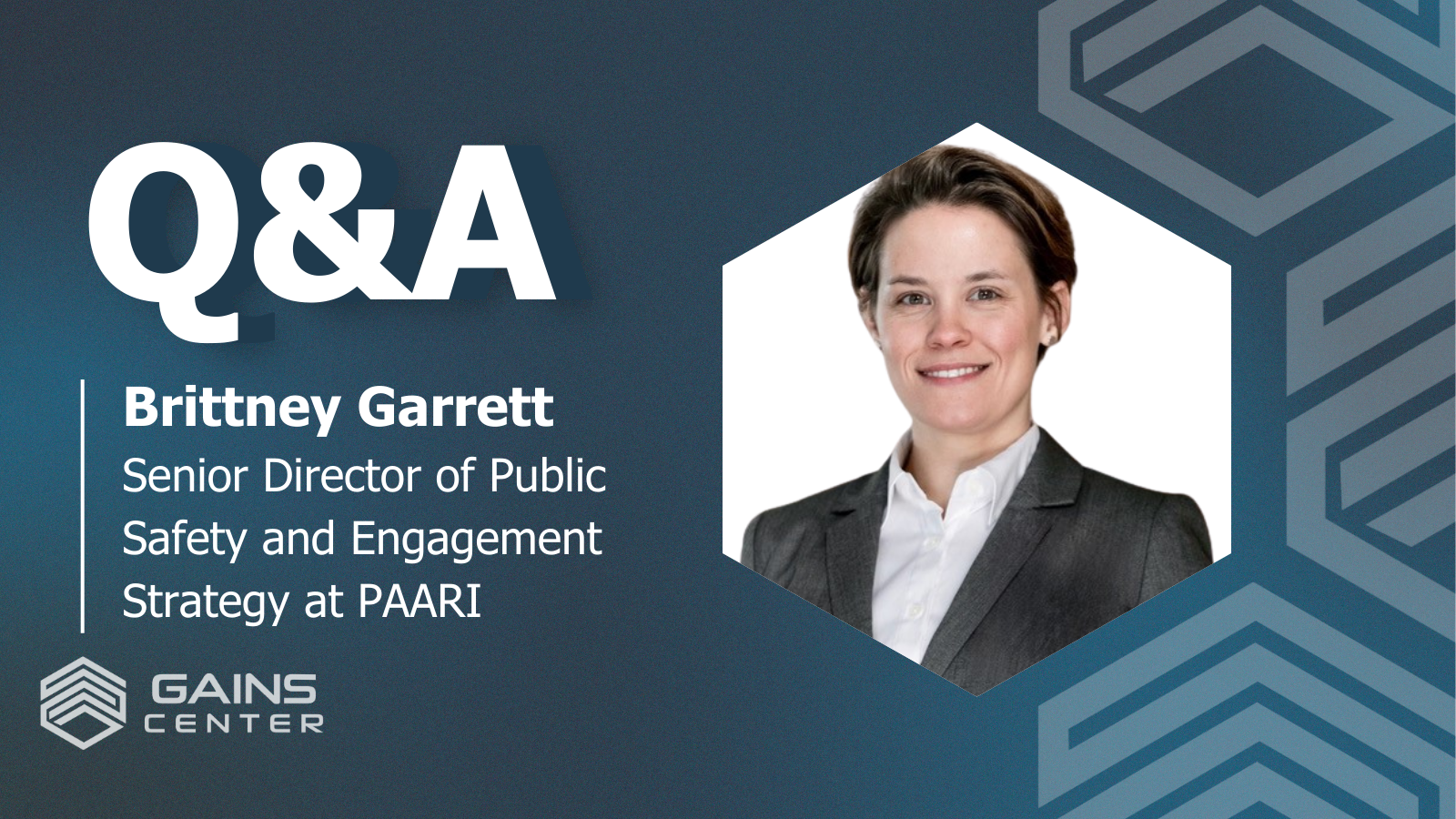
Brittney Garrett is the senior director of Public Safety Engagement and Strategy at the Police Assisted Addiction & Recovery Initiative (PAARI). An experienced law enforcement professional, Garrett has received recognition for her leadership in developing the Jeffersontown Angel Program, among other accolades.
You’re credited with developing the first Angel Program in Kentucky. What inspired you to do this?
As a patrol officer in Jeffersontown, Kentucky, I noticed a sudden increase in overdoses. In fact, at the time (2015), Jefferson County had the most overdose deaths of any county in the state. A friend passed along an article about the newly established Angel Initiative in Gloucester, Massachusetts, where the police department opened its doors to anyone who wished to turn in drugs and drug paraphernalia. No charges were pressed, and the individuals were connected to treatment resources. I remember thinking, “Wow—how innovative!” But the program hadn’t proven itself yet, which prompted caution among our leadership.
By 2016, I had become an administrative sergeant, responsible for developing community and organizational projects to increase accountability and effectiveness. And research on the Gloucester program presented in the New England Journal of Medicine revealed a nearly 95 percent rate of direct referral to treatment resources, which was far higher than local hospital initiatives.
When I saw the impact of the Gloucester program, I knew it was the right thing for us to do as a law enforcement agency. It had the potential to create trust and connection with law enforcement, divert people from involvement with the criminal justice system for drug-related crimes, and remove barriers to treatment. Securing support from our leadership and our city council really empowered me, even though I had so much to learn.
What advice do you have for communities seeking to establish a deflection/diversion program?
One of the first things I recommend is to foster buy-in from the community and from law enforcement. When we started in Jeffersontown, we partnered with several treatment centers to run information booths. For example, Narcan was not well known at the time, but we demonstrated to the community how its use by the police department saved 3 lives in 1 month.
Individuals and families were hurting and desperate for resources. We conducted community forums to describe the department’s plans and to answer questions. This prompted many community members to ask how they could contribute. To facilitate this involvement, we knew our staff needed education on the science of addiction, stigma of addiction, and peer support.
A local treatment center provided this training, which was mandatory. More than one officer started the training with arms crossed, sitting very quietly in the back of the room. Peer specialists in recovery who had served time in jail provided Q&A sessions during the training, which proved to be a game changer because it humanized people in recovery. The dialogue that opened up was mind-blowing. Officers shared how they had lost family members to overdose, but stigma had previously prevented them from speaking openly about the loss. Happily, conversations about wellness and mental health within law enforcement are happening more readily now.
Rapport building with the community also set the stage for funding the program, starting with a small donation from a local community organization, gaining strength with two significant grants, and then ultimately being included in the city budget. The initial donation felt like a fortune at the time because we had no funding. It allowed us to transport individuals to treatment centers, which was a notable barrier at the time. Churches also jumped in with donations and gift cards. Every bit helps, down to the snacks and water we offer to folks who come in seeking assistance, often hungry or dehydrated. We also relied heavily on volunteers, mainly young people in recovery, to develop rapport with people in the community who used drugs and didn’t trust the police.
How does your past professional experience inform your current role with PAARI?
PAARI was established to advance law enforcement agencies’ adoption of non-arrest pathways to recovery, like the Gloucester model. It has naturally grown to address related topics, such as post-overdose outreach and co-responder programs. I serve as a liaison to more than 800 police and public safety partners in 46 states. They are at various stages, from considering how to implement deflection and diversion initiatives in their agency to enhancing initiatives already in place.
I loved many aspects of my job in the police department, but supporting people through the Angel Program is the most fulfilling work I’ve ever done in law enforcement. It really changed the trajectory of my career.
Coming to PAARI has allowed me to devote my energy to supporting programs and helping sustain them. As someone who’s navigated the implementation process, there’s little I haven’t seen or heard or dealt with, from interacting with a difficult provider to resolving insurance questions, from procuring Narcan and fentanyl test strips to providing strategic guidance.
I think it’s human nature to trust people who are like us: researchers trust researchers, police officers trust police officers, etc. My “boots on the ground” experience and high-level understanding of policies and procedures bridge the gap for law enforcement professionals who are trying to rethink police work.
Do you have a success story that best demonstrates the positive impact deflection/diversion can have?
Quantitatively, the numbers speak for themselves. For example, Michigan’s Hope Not Handcuffs program and Anne Arundel County’s Safe Stations (Maryland) have connected thousands of people to treatment.
What speaks the loudest, however, is the change in individuals’ lives. Of the many success stories I’ve heard, one that immediately comes to mind is a woman who was very sick from methamphetamine use disorder. We were able to place her in treatment, and she maintained recovery for about a year. I didn’t hear from her for several months, until I received a call from a correctional facility in a neighboring state. She had resumed use and wrapped her car around a tree. The county where she was arrested had no treatment court, so after serving her time, we reconnected her to treatment.
She has since secured housing and gotten married. She finished college and has a job. She’s regained custody of her child and rebuilt her relationship with her mother. We didn’t help just that woman; we showed her whole family they could trust law enforcement and perhaps prevent future substance use issues. It’s a ripple effect.
Another thing that I learned from this person’s experience is the debilitating sense of shame associated with resuming substance use. Despite keeping in frequent touch with me for many months, she didn’t want to tell me that she had started using again. I wish I had learned the science behind substance use disorder, the mental and physical toll of it, earlier in my career. But the Angel Program provided this understanding—a profound impact that changed how I served my community as a law enforcement officer.