

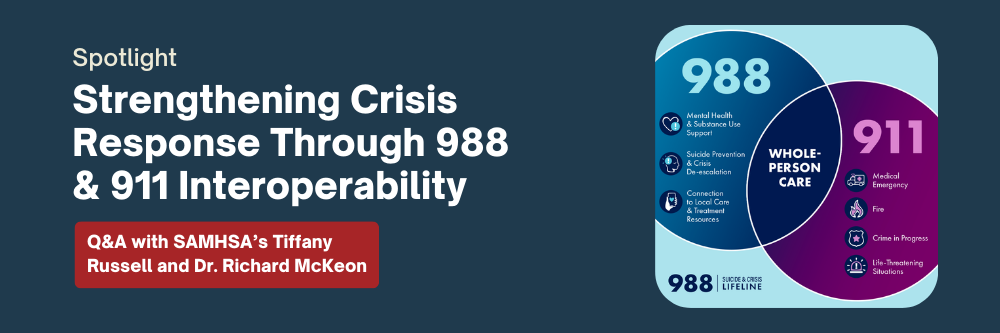
In January, the Substance Abuse and Mental Health Services Administration (SAMHSA) released a new resource: 988 & 911: Strengthening Crisis Response While Managing Risk and Liability.
The Veterans Crisis Line is available to Veterans and their supporters 24/7.
For decades, 911 first responders – police, emergency management services, fire fighters – were tasked with responding to any and all crisis situations in communities. This system, while pivotal, was not designed to effectively address behavioral health emergencies. Since the nationwide launch of 988 and its integration with the Veterans Crisis Line (Dial 988 then Press 1), many communities have successfully redirected behavioral health crisis calls away from law enforcement–led responses and toward specialized mental health support. However, concerns about legal risk, liability, and interagency coordination have slowed progress in other regions. This new resource directly addresses those concerns with practical, actionable guidance to clarify roles, reduce perceived risk, and build trust across systems.
This month, the Substance Abuse and Mental Health Services Administration’s Service Members, Veterans, and their Families Technical Assistance Center (SAMHSA’s SMVF TA Center) reached out to two vital champions of 988, Tiffany Russell and Dr. Richard McKeon, for their insights into key aspects of successful coordination and the role of the lifeline in the overall goal of reducing suicide.
As SAMHSA’s Chief of Crisis and Justice Initiatives with SAMHSA’s 988 and Behavioral Health Crisis Coordination Office, Tiffany serves as an advisor to the 988 director and other members of SAMHSA’s senior leadership in planning and determining policy, programs, and activities that address complex challenges in coordination of 988 crisis centers with law enforcement, 911 call centers, and emergency medical service providers. She also develops, recommends, and implements programs and provisions of guidance related to improving crisis response and equitable access to services for individuals with behavioral health needs that minimize unnecessary law enforcement involvement and promotes diversion from the justice system.
Dr. Richard McKeon, Senior Advisor in SAMHSA’s 988 and Crisis Office, served for 12 years as Chief for the Suicide Prevention Branch in the Center for Mental Health Services where he oversaw all branch suicide prevention activities, including the Garrett Lee Smith State/Tribal Youth Suicide Prevention, and Campus Suicide Prevention grant programs, the Zero Suicide initiative, the Suicide Prevention Resource Center, and the Native Connections program. He has worked with the National Suicide Prevention Lifeline since its inception in 2005, including establishing the foundation for 988 as the national suicide prevention number.
Tiffany Russell:
This resource reminds us that local champions are important facilitators for weaving 988 and 911 operations. Who makes an effective local champion? Do they typically come from a certain background or perspective?
An effective local champion is someone who believes deeply in a shared vision of 988/911 interoperability and is willing to actively foster collaboration across systems. As the toolkit notes, successful interoperability depends on cross-system leadership and shared ownership among diverse partners.
Champions are not defined by job title as much as by mindset. They:
- Advocate for clear roles and responsibilities between systems
- Foster trust and transparent communication
- Promote creative problem-solving
- Push for policies and funding that strengthen integration
- Help reduce fear around perceived liability
The toolkit specifically calls on “Champions” to advocate for policies and funding that integrate 988 and 911 systems to ensure a smarter, more compassionate emergency response system. In my experience, champions come from many backgrounds—988 center leadership, 911 administrators, behavioral health authorities, Medicaid agencies, law enforcement leaders, and individuals with lived experience. What unites them is not their discipline, but their commitment to improving outcomes for people in crisis and their willingness to bridge systems that historically operated in silos.
The resource outlines interorganizational trust as key and suggests ride-along or sit-along experiences. When 988 counselors and 911 dispatchers or law enforcement participate in these experiences, what surprises them?
The toolkit emphasizes relationship-building and trust as foundational to reducing both perceived and real liability concerns. Sit-alongs and ride-alongs are powerful because they humanize each system.
What surprises them?
For 988 crisis counselors:
- The speed and complexity of 911 dispatch environments
- The split-second decisions dispatchers must make under high pressure
- The real safety risks responders face in the field
For 911 dispatchers and law enforcement:
- The depth of clinical risk assessment 988 crisis counselors conduct
- The structured triage processes used to categorize risk levels (low, mild, moderate, higher risk)
- The focus on de-escalation and least restrictive response whenever possible
Often, both sides are surprised by how aligned their goals really are. Both want to ensure safety, prevent harm, and connect people to the right resources. The ride-alongs and sit-alongs help shift the narrative from “handoff of risk” to “shared responsibility,” which is central to building interorganizational trust.
Dr. Richard McKeon:
What, if anything, has surprised you over the course of the transition to 988 since its rollout began in 2022?
What has surprised me the most (and it is a pleasant surprise) is the extent to which states, communities, advocates, persons with lived experience of suicidal crisis or suicide loss, all across the country, have joined together to promote the awareness and utilization of 988, leading to significant, ongoing increases in 988 calls, chats, and texts. In SAMHSA’s report to the FCC under the National Suicide Hotline Improvement Act, we expressed the belief that a 3 digit number would be more likely to be utilized in a suicidal crisis, and that is what is now happening because of the efforts of so many people and organizations.
In five or ten more years, what successes in the ongoing 988 work do you hope we’re celebrating?
In ten years, I would hope we would be celebrating 988/911 collaborations all across the country as part of a more comprehensive network where all those in suicidal (or other behavioral health) crisis who contact 988 receive the follow up services they need. While we have excellent evidence that those who contact 988 receive excellent care during the contact, reducing hopelessness, emotional distress, and suicidal ideation, SAMHSA’s goal is to have 988 linked to a coordinated, comprehensive care system, where everyone gets the care that they need.
In your role at SAMHSA and throughout your career in suicide prevention, what have been the most interesting and/or rewarding aspects of your work?
I think that having been engaged with the National Suicide Prevention Lifeline since its launch in 2005, and now being engaged with 988, I have seen that major, transformational change can occur . My previous work with implementation of the Garrett Lee Smith Memorial Act showed that youth suicide can be reduced in counties implementing SAMHSA grant-funded activities. My hope is that we will similarly be able to demonstrate that 988 is reducing suicide across America.
Additional Resources
- 988 Lifeline
- VA.gov/Reach: The Don’t Wait, Reach Out. campaign encourages Veterans to reach out for help before their challenges become overwhelming or reach a crisis point.
- Veterans Crisis Line: If you’re a Veteran in crisis or concerned about one, contact the Veterans Crisis Line to receive 24/7 confidential support. You don’t have to be enrolled in VA benefits or health care to connect. To reach responders, Dial 988 then Press 1, chat online at VeteransCrisisLine.net/Chat, or text 838255.
Special thanks to Tiffany Russell and Dr. Richard McKeon for sharing their expertise and for their contributions to the work of preventing suicide among SMVF.
Thank you for your continued support and dedication to improving behavioral health care for those who have served, and are currently serving, our country.
SAMHSA’s SMVF TA Center is honored to provide TA to states, territories, and communities seeking to strengthen their behavioral health support for those who have served in the armed forces. For TA inquiries, please email smvftacenter@prainc.com. For more information about the SMVF TA Center and the resources offered, please visit SAMHSA’s SMVF TA Center’s web pages.