


Julie Phillips, Shared Services Program director at the Mid-America Regional Council (MARC), and Shannon Moss, chair of the 988 Mobile Crisis Response Steering Committee, describe their combined efforts to create more efficient and standard mobile crisis response services in the region of Kansas City, Missouri, thereby helping deflect and divert adults experiencing mental health crises from involvement with the criminal justice system.
In autumn of 2022, MARC engaged in a 4-year Cooperative Agreement for Innovative Community Crisis Response Partnerships (CCRP) with the Substance Abuse and Mental Health Services Administration (SAMHSA). What do MARC and its partners hope to achieve with this funding?
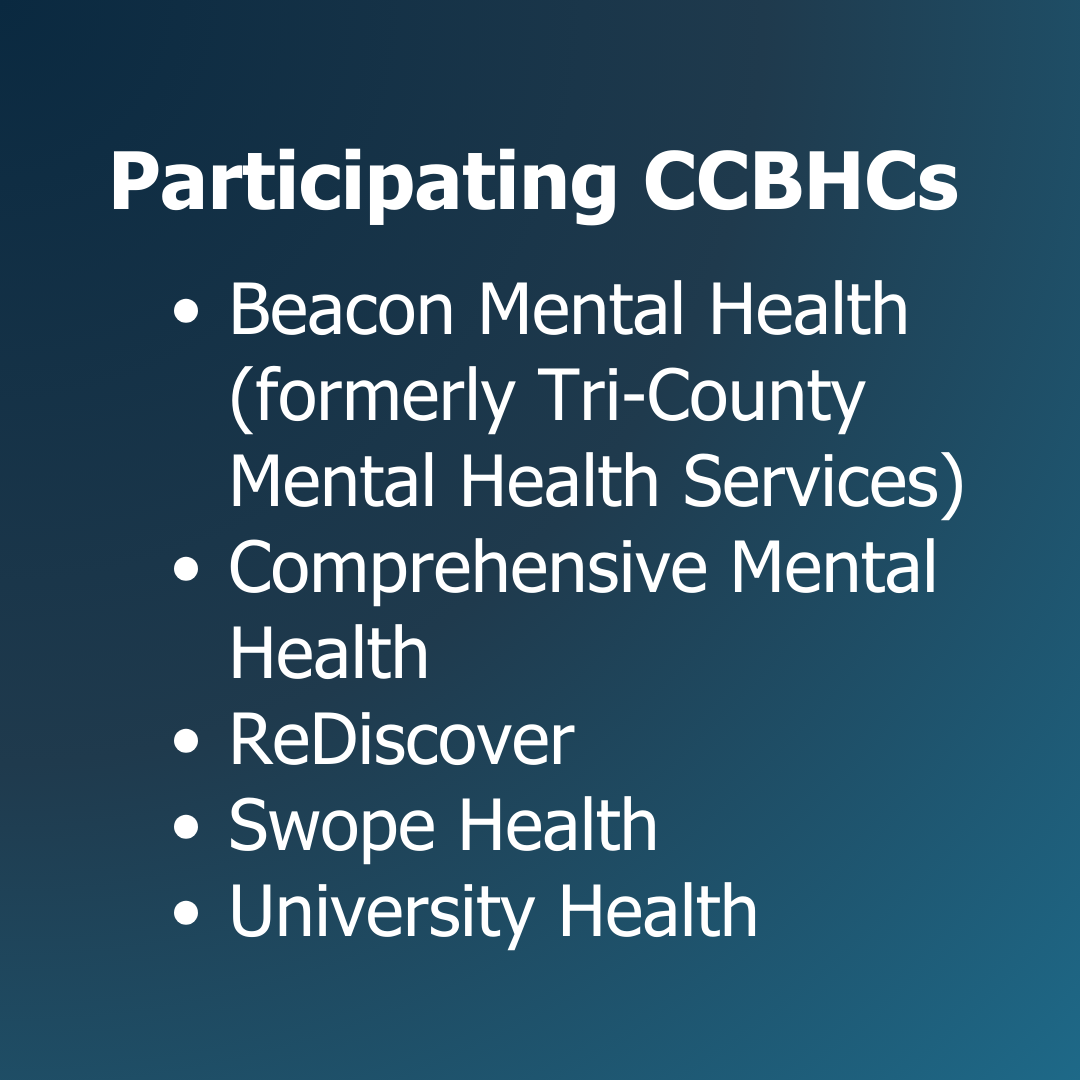
Figure 1
Shannon: Well before the nationwide launch of the 988 Suicide & Crisis Lifeline, five Certified Community Behavioral Health Clinics (CCBHCs) (Figure 1) in four Kansas-bordering counties of western Missouri had started discussing what an ideal crisis system would look like in our bi-state region. We soon realized that the key to ensuring consistent service provision was collaboration, so we convened crisis leaders from each of the five CCBHCs, law enforcement, and other community partners. This coming together was truly groundbreaking.
We then invited MARC to join the conversation as a nonbiased partner who could facilitate the collaborative, thereby putting all partners on equal footing. MARC led a strategic planning process, soliciting feedback on the ideal crisis response system from community members, stakeholders, mental health partners, and individuals with lived experience. The strategic plan, complete with recommendations, was issued in July 2022.
The recommendations included securing funding to support multiple aspects of our vision for consistent crisis responses across the region, as well as to move the group forward as a collaborative. The release of the CCRP notice of funding opportunity was remarkably timely, and we are so grateful to SAMHSA for helping us carry out the recommendations. The safety measures we have put in place and the resources we have made available thus far are largely due to CCRP funding.
As the facilitator for the collaborative, what does MARC’s role involve?
Julie: As Shannon mentioned, MARC led the strategic planning that ultimately informed the goals and objectives for CCRP funding. We now serve as an umbrella for the collaborative, which includes convening, facilitating, and following up on bimonthly meetings; tracking grant deliverables and action items; and overseeing budgets. CCBHC staff are in the community doing the crisis response work; our support frees them up to do their jobs and builds capacity.
Councils of government, such as MARC, are often thought of as “conveners” because we bring people together around shared issues of concern to advance their mission. The complexity of this CCRP initiative makes this role particularly important. First, we have five CCBHCs, whose catchment areas are sometimes only a street apart, and CommCARE as their 988 call center. The CCBHCs are a geographic mix of urban, suburban, and rural communities, all with unique needs and resources. Layered on top of that is the number of police departments, EMS departments, and fire districts—there are many jurisdictions!
Sitting on a state line, we are also continually seeking ways to serve both our Kansas and Missouri partners. For example, we are building a contact list to ensure warm hand-offs to follow-up services, even for mobile calls involving someone who lives outside of the four-county region.
What success has the collaborative achieved so far?
Shannon: We saw a 177 percent increase in individuals served by mobile responses from year 1 of the grant to year 2. Of those calls, 83 percent were resolved in the community, meaning no transfer to jail, prison, or police departments. These numbers were made possible by many accomplishments, but perhaps the greatest was breaking down walls between agencies.
To do this, we established the 988 Mobile Crisis Response Steering Committee, which includes crisis directors and staff from the five CCBHCs and CommCare staff. Technical advisors, such as law enforcement officers, are invited to Steering Committee meetings as needed. Initially, much of the committee’s time and energy was devoted to establishing shared definitions, processes, and workflows.
The resulting sense of unity helped us then tackle staffing, which looks slightly different for each region. For instance, the two CCBHCs in the urban core of Kansas City really joined hands by sending one staff member from each agency to form the two-member team of trained mental health professionals established by the Steering Committee as a best practice for a mobile response. This co-mingling of staff and resources had never happened before.
We are also proud of the strong relationship we have developed with law enforcement and first responder partners. Law enforcement is so impressed with our work that they now call to link us in during circumstances calling for mental health expertise. Additionally, CommCARE signed a memorandum of understanding with the largest police department in the four-county region to enable appropriate mental health-related calls to be routed from 911 to 988. This agreement allows 911 calls to be transferred, with the caller’s permission, to 988 when appropriate, which frees police and fire staff to focus on activities better aligned with their expertise.
What is the purpose of the advisory council associated with your 988 and mobile crisis response work?
Julie: From the very beginning of this work, we knew how important it was to involve community members. While our Steering Committee serves a very important function, it is made up of clinicians. To ensure community members also have an opportunity to share their voice, we invited people from all over the region to sit on an advisory council. The council serves as a sounding board for new ideas, as well as a feedback loop. By the latter, I mean members candidly share with us what they hear about recipients’ experience with our services.
Another purpose of the council is to raise awareness among and educate family, friends, co-workers, and neighbors. Despite CommCARE’s excellent “Get the Words Out” campaign, we still have folks who don’t know about 988 and our mobile crisis response services. We are working to change that and are very excited to have the help of the advisory council.
In closing, as demonstrated by the numbers shared, MARC has carried out CCRP’s intent to divert individuals experiencing mental health crises from law enforcement through enhanced mobile crisis response teams. Moreover, first responders and all of Kansas City are benefitting from the seamless, multiple-agency collaboration that this hard work has forged.